Architecture & places to visit
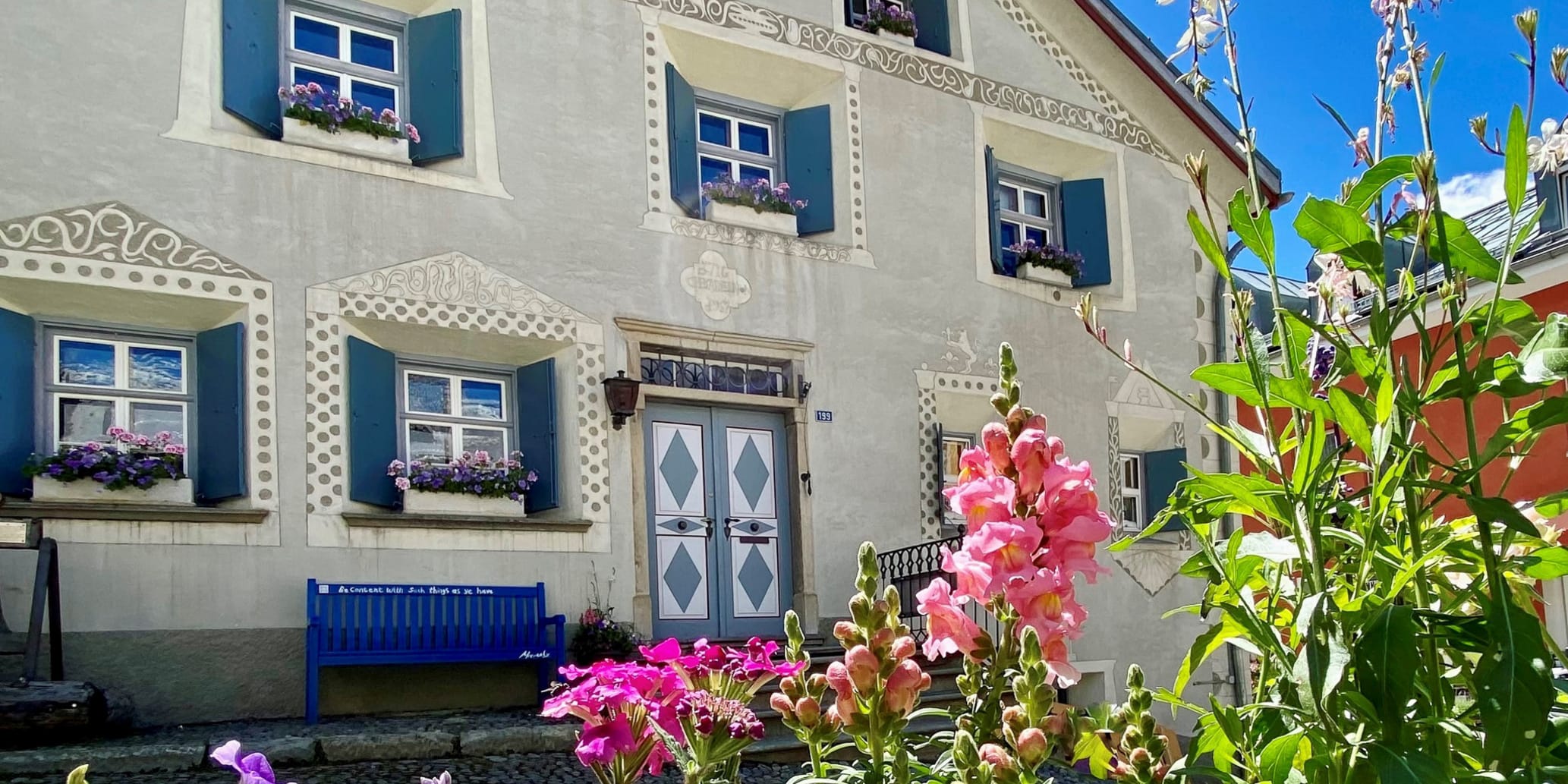
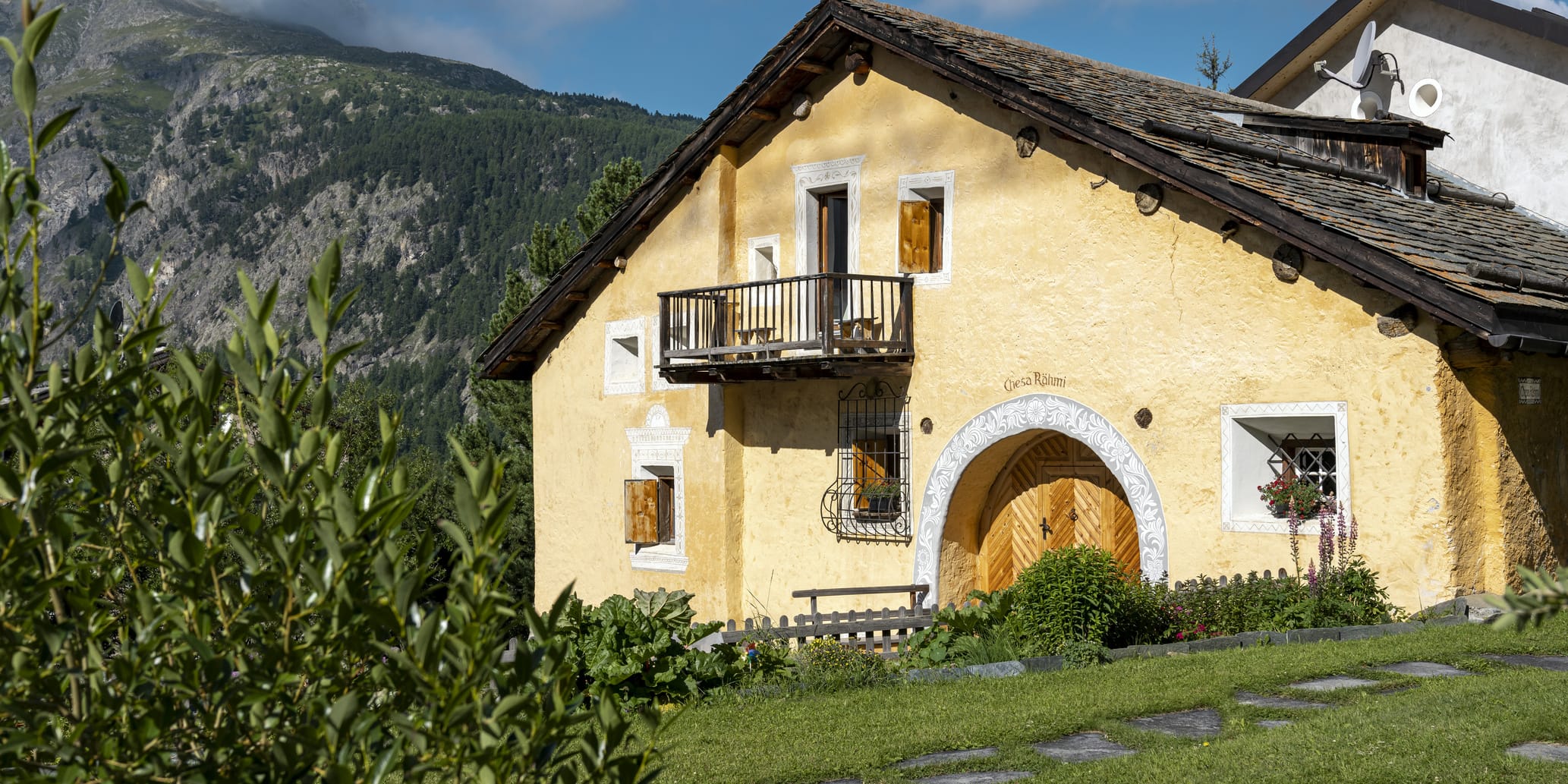
The architecture here sheds light on the exciting history and development of Pontresina. Despite its modern and open-minded nature, this popular mountain Town has retained its fairytale, romantic character to this day and invites you to reminisce on the past.
Engadin Buildings and the ‘Sgraffito’ decorative method
The typical Engadin buildings underscore the rural and agricultural origins of Pontresina. The voluminous farmhouses date back to the 17th and 18th centuries. Features include the small windows to keep the warmth in, the bay windows, and the attached, adjacent barn (the ‘Sulèr’), the large entrance doors and, of course, the ornate decoration of the walls. This type of decoration of the exterior rendering of buildings is called ‘Ssgraffito’. The mostly abstract motifs are scraped off the still damp top layer of rendering, revealing the darker layer underneath. You can learn how people lived in a historic Engadin house at the local Museum Alpin. ‘Allegra’ and ‘Bbainvgnieu’.


Belle Époque (Victorian and Edwardian) and modern architecture
The first tourist boom in Pontresina dates back to the ‘Victorian and Edwardian’ Belle Époque. Some particularly beautiful hotel buildings, some even of national importance, bear witness to this period of time. The hosting tradition of the Grand Hotel Kronenhof dates back to around 1848. Nota bene, the year in which modern Switzerland was born and the origin of the constitution that still unites the country today. The ‘Neo-Baroque’mansion-like Kronenhof is one of the most architecturally significant Alpine hotels of the 19th century and is a listed building. The proud Saratz, Walther, Schlosshotel and Sporthotel hotels also boast phenomenal ‘Art Nouveau’ elements. At the other end of that time-line, there stands the Hotel Maistra 160. It represents one of the latest hotels to be erected in Pontresina, and bears the signature of the renowned Grisons Architect Gion A. Caminada. The style is high alpine, minimalist and follows the motto "form follows function".


The Church of Santa Maria
The Sta. Maria funeral church is one of the most precious sacred buildings in the whole of the Canton of the Grisons. It includes famous medieval frescos dating back from the 13th century, including high-quality Byzantine-Romanesque fragments as well as a Lombard Cycle from 1495. After an enlargement in 1495, the church was completely repainted, over the old frescoes. During the restoration of the west wall and the tower from 1962 to 1976, a Mary Magdalene cycle with 18 images was uncovered. An exciting discovery. The Santa Maria mountain church is dedicated to Mary Magdalene and, as the church of the ecumenical cemetery, is owned by the Political Municipality of Pontresina. Church services and Vesper Concerts are also held here. This romantic small Mountain Chapel is also very popular for weddings and attracts couples from all over the world. The church can be visited as part of a guided tour or during general opening hours.
Spaniola Tower
The pentagonal ‘Spaniola Tower’ is a real curiosity in Pontresina. It was built around 1200 from irregular quarry stones and boulders. To protect against avalanches and rock fall, but also for strategic reasons. The pointed aspect faces the mountainside. The round-arched high entrance is clearly visible, but it is no longer possible to say whether the Tower was connected to a residential building by an underground passage. The Tower, idyllically situated on the upper edge of the Town, was extensively restored by the Municipality in 1994. Since then, it has once again towered over the former capital of the medieval Upper Engadin in its original splendour. Right next to the mountain church of Santa Maria and between the access to the ‘Steinbock Promenade’ and the ‘Röntgenweg’. The latter is named after regular guest Wilhelm Conrad Röntgen. The German physicist and Nobel Prize Winner spent no fewer than 43 summers in Pontresina (Dr. Röntgen developed the X-Ray technology in 1895).
The ‘Ova da Bernina’ Whitewater Gorge
More
The Bernina Fortresses
The Bernina Fortress Complex is a testimony to different eras of particularly insecure times in Central Europe. Here you will find the remains of fortifications from before the First World War, but also, for example, artillery fortifications, which were once secret and were the last to be installed in the world (21st century). The Bernina Pass was once unsuitable as a military barrier. The vast moraine landscape is much too un-overseeable. Nevertheless, a suitable site was finally located around 6 kilometres north of the top of the pass towards Pontresina. The main Bernina fortifications on the right-hand flank were once armed with an infantry cannon and three Swiss Army machine guns. Three machine guns were operated from the Bernina flank on the left-hand side. The anti-tank barrier between the two fortifications consists of three rows of natural stones set in concrete, partly supplemented with concrete blocks. Efforts are currently underway to make the fortresses on the Bernina Pass into architectural monuments of national importance, open to the public.
UNESCO World Heritage Site
More